


Ethiopia
Land of diversity and cradle of humanity
Ethiopia is a fascinating country with stunning landscapes, wonderful people, and a rich culture, located in the heart of East Africa. It is a land of contrasts: known as the cradle of humankind.

Ethiopia geographically:
The "Federal Democratic Republic of Ethiopia" is the tenth largest country in Africa with 132 million inhabitants.
It is located in the northeast of the continent and in its total area is three times the size of Germany.
Ethiopia is surrounded by Sudan, Somalia, Kenya, Djibouti and Eritrea.
Ethiopia has had a constitution since December 1994 that has many similarities to the German Basic Law.
There are 12 regions (comparable to our federal states); plus 2 regionally independent cities (Addis Ababa and Dire Dawa).
The capital city Addis Ababa covers 250 km² and has approximately 3-5 million inhabitants.
The population of Addis Ababa is around 5.7 million, the population of Tigray (the region where we work) is 6-7 million.


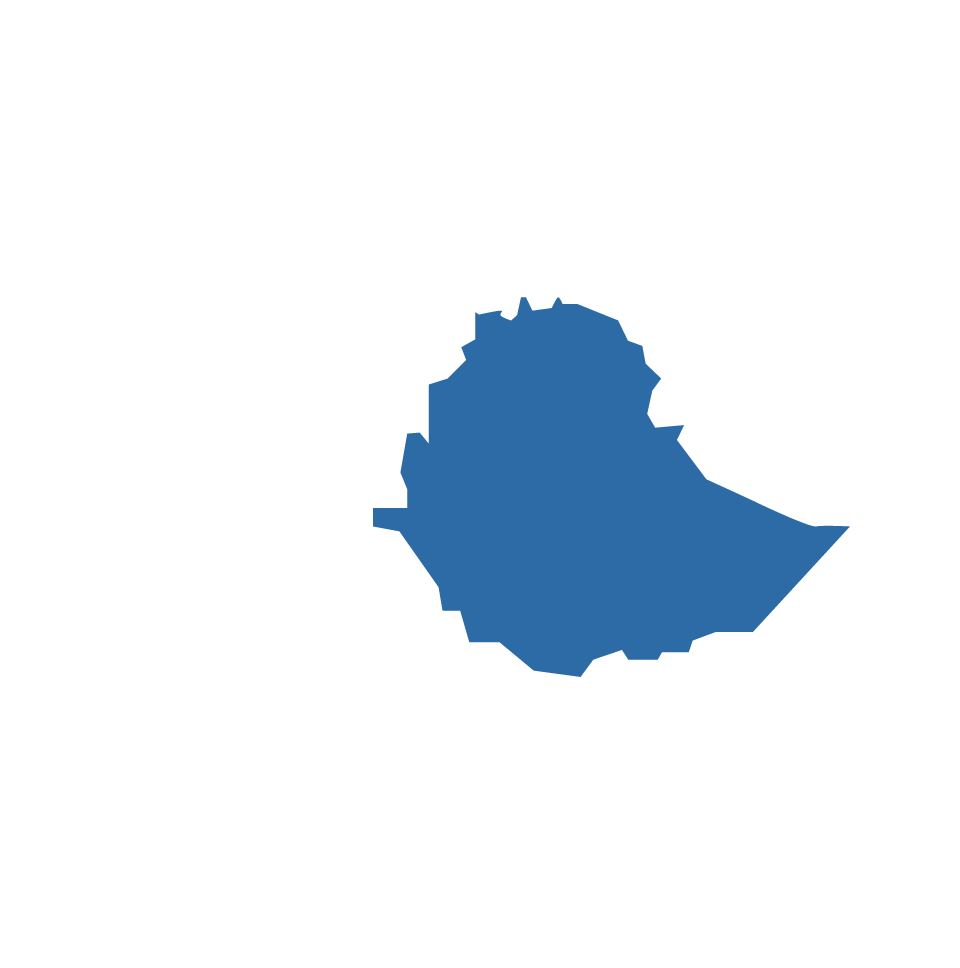
Ethiopia in a short outline
The country’s history has not been easy, and it has repeatedly experienced armed conflicts. To this day, the border with Eritrea remains closed.
Ethiopia is also called the “roof top of Africa” because about half of the country is 1200 m above sea level and a quarter even 2,000 m above sea level. At 4,620 m, Ras Dashen Terara is the highest elevation in the country.

Sources: Wikipedia
The landscape is very multifaceted. These range from deep valleys that divide the large country to high mountains with alpine flora and fauna to savannah with giraffes and elephants. Hard to imagine for us Europeans, but tropical jungles and barren salt steppes can also be found here.
There are weather zones that differ mainly in the altitudes:
- the tropical-hot zone in areas with an altitude of up to 1,800 m. Here there is an average temperature of 27°, in some regions
- the temperature can even rise to 60°; the annual rainfall is less than 500 mm.
- the warm-temperate zone in areas with an altitude of 1,800 – 2,500 m. Here there is an average temperature of about 22° with an annual rainfall of 500 – 1,500 mm.
- the mountain area at an altitude of over 2,500 m. The average temperature here is 16° and 1,800 mm of rain falls annually.
There is a main rainy season, which is between mid-June and September and a small rainy season between February and March.
In the northern part, however, the rain falls irregularly, which can lead to devastating drought disasters. This also includes the Tigray region, in which the city of Axum is located, among other things. It is estimated that half of Ethiopians are undernourished, so that millions of people are dependent on food aid even in good harvest years. In addition to the droughts that occur, the causes of this are also floods, which makes help from abroad necessary.

Sources: Wikipedia
To make matters worse, the inadequate infrastructure makes it very difficult to exchange agricultural goods. The country’s main exports are coffee, tea and oilseeds. Germany is the main buyer of coffee exports with about 30%.
With an annual per capita income of 660 US dollars (2024), Ethiopia is one of the poorest countries in Africa and ranks 173rd (out of a total of 186) according to the United Nations Human Development Index (HDI).
Offiziell gilt in Äthiopien eine Schulpflicht; sie wird jedoch nicht konsequent durchgesetzt. Viele Kinder müssen, vor allem Mädchen in ländlichen Gegenden, in der elterlichen Landwirtschaft oder im Haushalt helfen, so dass hierdurch der Besuch einer Schule oftmals nicht möglich ist. Das hat zur Folge, dass in Äthiopien in etwa 64% Analphabeten leben, darunter 54% Männer und 75% Frauen.
Interesting:
In Ethiopia, the Julian calendar applies, which means that the year is seven or eight years behind our calendar according to the Gregorian calendar. The question of whether it is 7 or 8 years depends on the date, as the Ethiopian year begins on 11.09. This is also the reason why the millennium celebration in Ethiopia did not take place until 11.09.2007!
There is also a special feature in Ethiopia when it comes to the months. There are twelve months with a duration of 30 days each. In addition, a thirteenth month with 5 or 6 days, which depends on whether it is a leap year. That’s why Ethiopia can advertise 13 months of sun.
Excerpt of the holidays in Ethiopia:
07 January: Genna (Christmas)
19 January: Timkat (Baptism of Christ)
01 May: Labour
Day 11 September: Ethiopian New Year
April/May: Good Friday and Easter
(Sources: Wikipedia, BMZ website and “Ethiopia – Handbook for Individual Discovery” by Katrin Hildemann and Martin Fitzenreiter)
Aksum
and its surrounding area
Axum (also spelled Aksum and Akhsum)
Axum is located in the northern region of Tigray and is about 50 km from Eritrea and about 1,005 km from Adis Ababa, the capital of Ethiopia. The city at the approx. 1 km wide exit of the valley between the two hills Beta Giyorgis and Mai Qoho, which are up to 2,200 m above sea level, occupies an area of approx. 1.5 km². About 56,500 inhabitants live here.
Politically, Axum is a small district capital that was added to the UNESCO World Heritage List in 1980 due to its historical ruins and outstanding history.
The city itself developed in parallel with the development of the Axumite culture. In its long history, it has been severely damaged and partially destroyed several times in armed conflicts. Probably the word Axum itself can be translated as “water/well of the prince”.
It is not known when Axum became the capital of the Axumite Empire. Axum is mentioned for the first time in a Greek text in the first century AD (in the Periplus Maris Erythraei, a manual for sailors of the Red Sea).
The monuments of this city, especially the stelae, are symbols of millennia-old culture.
The city’s stele park in particular is a landmark. The stelae are parts of tombs that have been preserved to this day. The most impressive of the stelae is one of the largest worked monoliths in the world, which lies on the ground and was originally 33.50 m high and weighs around 520 tons. It is assumed that this stele could never be erected, but broke when it was erected.
For the Ethiopian Orthodox Christians, with their special, independent faith, Axum is comparable to Rome. The largest sanctuary in Ethiopia is located in the cathedral. This is the holy ark of the covenant with the tablets of the 10 commandments that God sent to Moses. According to the legend of the Kebra Nagast, the Ethiopian royal chronicle, it is said to have been stolen from the temple of Jerusalem. A monk is still entrusted with the lifelong office of guarding the Ark of the Covenant. This task will be taken over by a successor before his death.
Axum today:
Today, Axum is a city that has grown over the last few years. In addition to many traditional buildings, there are now also modern and stone buildings. The stones are quarried from the surrounding mountains for construction. However, many parts of the city still consist of mud buildings and the inhabitants live in very poor conditions. Despite the great poverty that sometimes prevails, the city has also reached hotel chains and souvenir shops. In addition, there is also a small airport for domestic and international flights. Other means of transport are buses and shared taxis. Tourism provides income for the city and small traders. For the residents themselves, however, these tourist activities are far from their personal standard of living and often quite arduous everyday life.
A really big recent achievement is the supply of clean drinking water in the city area. The majority of the inhabitants enjoy this benefit. However, just as with the power supply, there is no guarantee of a continuous supply of drinking water and so unexpected supply disruptions occur again and again.
Questions about Ethiopia and Aksum?
Here we answer frequently asked questions and provide you with the most important background information about the region and the transparent work of Hawelti e.V. on site.
Is Ethiopia a safe travel destination and is tourism in Aksum possible again?

Like many regions in East Africa, Ethiopia has been affected by political tensions in recent years. While large parts of the country are stable, the situation, particularly in the Tigray region (Aksum), is complex as a result of the conflict. Tourism in Aksum has been severely impacted. We recommend always checking the latest travel and safety advice from your government's foreign ministry before traveling. Our association's work is carried out in close cooperation with our local partners.
What is the special role of the city of Aksum in Ethiopian culture and religion?
Aksum is the spiritual center of the Ethiopian Orthodox Church. The city is known worldwide because the Ark of the Covenant is said to be kept here in the Church of St. Mary of Zion. Aksum is also home to the monumental stelae, some reaching up to 24 meters in height, which represent the legacy of the ancient Aksumite Empire and are a UNESCO World Heritage Site.
In which language does Hawelti e.V. communicate locally and how do you ensure that the aid arrives?
Numerous languages are spoken in Ethiopia. The official language is Amharic. In the Tigray region (including Aksum, where we are primarily active), Tigrinya is spoken. Our vice-chair speaks this language, ensuring communication with all local contacts. Transparent communication is maintained through personal visits and close coordination with all relevant parties on the ground.
What currency is used in Ethiopia and how does inflation affect your projects?
The national currency is the Ethiopian Birr (ETB). Ethiopia has been struggling with high inflation for years. This poses a major challenge for our projects, as the costs of building materials, food, and local labor are rising sharply. We therefore rely on donations to offset these unforeseen price increases.
What is the difference between our "help for self-help" project and pure emergency aid?
While emergency aid (immediate assistance in Tigray) saves lives in the short term (food, medicine), "help for self-help" aims at sustainable structures. We invest in education, infrastructure, and the training of women so that people can become independent of donations in the long term and secure their own livelihoods.
How can I support Hawelti e.V. if I cannot donate money?
Even without monetary donations, there are many ways to support us: You can volunteer at regional events in Nuremberg (e.g., the coffee ceremony), set up one of our donation dinosaurs, help us spread our messages on social media, or organize donations of goods for our flea markets.